
Finding uses for a side stream is the easy part of upcycling. Deciding which ones to drop is harder.
In 2024, Europe’s largest food upcycling plant opened in Appenzell, Switzerland. Built by the startup Upgrain together with Brauerei Locher, it is designed to process around 25,000 metric tons of brewer’s spent grain a year into three grades: a flour substitute, a high-protein version and a high-fiber version.
The plant runs on one stream and one industrial partner, and sells three specifications a buyer can sign. Most food companies we work with start from the other end, with a long list of everything their side streams could become.
Every day, a plant already pays for the raw material, transport and energy behind a stream that leaves as waste. That makes it the asset with the lowest activation cost, as we argued in our report From 6% to 37%. The report maps EBITDA margin across the food value chain, from 6.4% in commodity processing to 37.1% in biosolutions, and turning by-products into ingredients is one of the four strategies manufacturers are using to move up it. You can access the full report here. Getting the tonnage and cost data is the first step. The next step, choosing which streams to pursue, is where most portfolios stall.
Three filters before any food by-product business case
Every by-product has to clear three filters before it earns a business case. The first two describe the stream itself, and no internal decision can change them. The third depends only on an internal decision.
1. The stream is consistent enough to hold a spec
Buyers sign specifications, not tonnage estimates. A stream that shifts with the season, the recipe or the production line cannot deliver the same composition every month, and no ingredient buyer will reformulate around it. Consistency is what gets a stream into a specification. Volume is what makes it pay: in our report, the manufacturers best positioned for this strategy had more than 50,000 tons a year of a homogeneous stream.
2. Someone will sign the spec, under a route you can meet
Who buys it. One stream can carry more than one business. Darling Ingredients sends what leaves the slaughterhouse to pharma and nutrition as collagen and gelatin, and to energy as renewable diesel. That is two buyers, each paying for a different property.
Most streams have more buyers than a plant assumes. Of the 27 side-stream startups we mapped, 12 sell to food makers. The rest reach consumers, cosmetics, materials and feed, and three need no buyer at all: the value stays in the plant’s own bill. See the full map below.
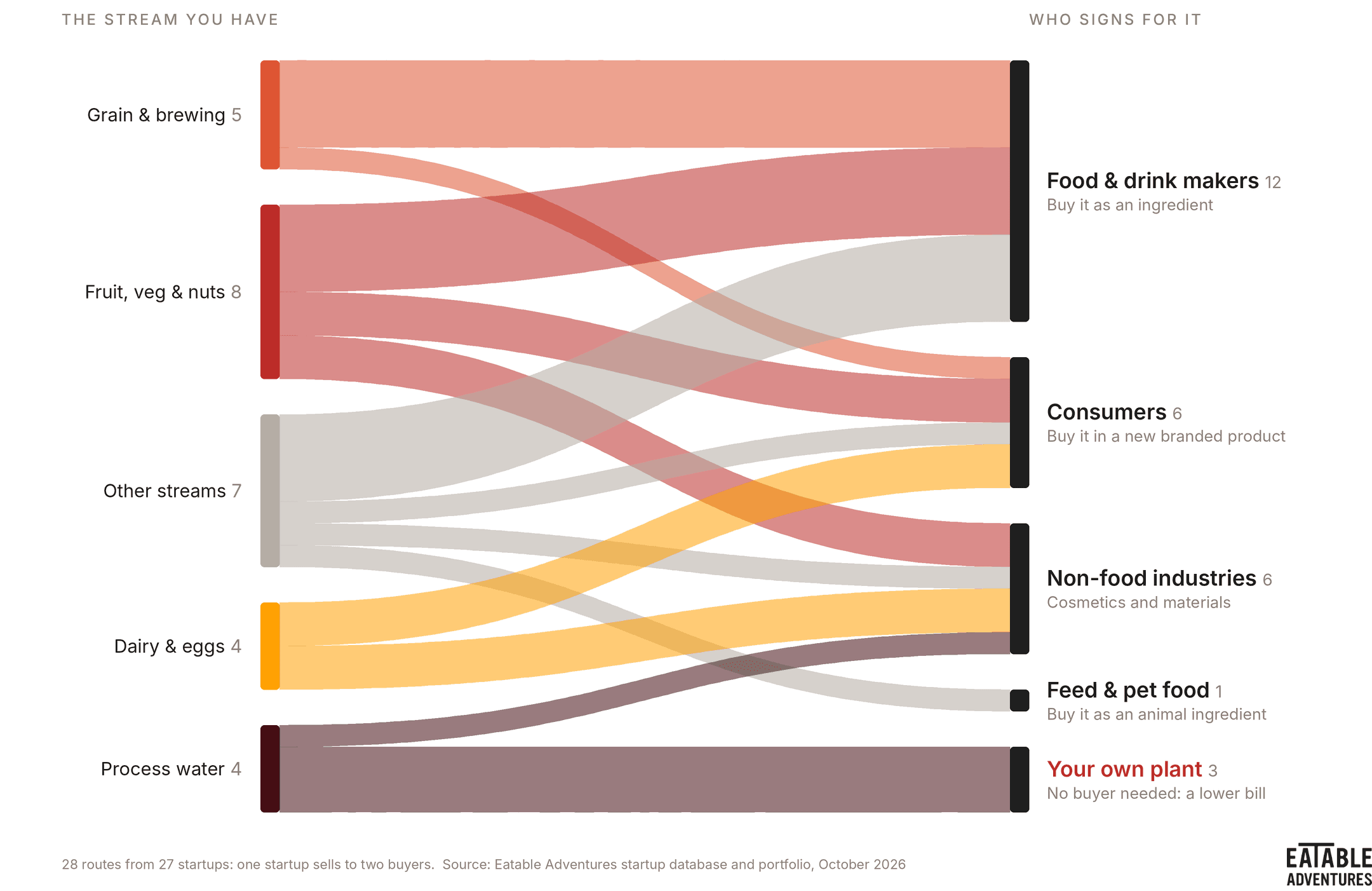
What route that buyer implies. Each buyer brings its own regulatory route, and food is not always the hardest. A fraction with a documented history of significant human consumption in the EU before May 1997 is not a novel food. Feed has its own framework: the EU catalogue of feed materials and, for streams of animal origin, the animal by-products rules.
Novel food authorization applies when the ingredient itself is new. By the end of 2023, EFSA had published 15 safety assessments of novel foods derived from food by-products. In June 2026, a soluble fiber made from carrot pomace, developed by the startup NutriLeads, received full novel food authorization in the EU, and Ingredion acquired it that same month. A mid-size plant rarely needs to run that process itself. Usually the buyer or the startup carries the dossier, and the plant’s job is to supply a stream that holds the spec.
3. The stream has one owner and one budget line
In most plants, a side stream belongs to operations as a disposal cost, to innovation as an idea and to quality as a risk. A stream shared by three departments rarely gets a decision from any of them. With a single owner and a budget line, a successful pilot has somewhere to go next.
Why focusing on two side streams beats a long list
Most portfolios we review already have uses and partners identified. They stall because nobody drops options before the first pilot.
The scale of a single stream is easy to underestimate. AB InBev’s spent grain protein business started as an idea at its R&D center in 2013 and took around seven years to become a company, EverGrain. Its $100 million plant still processes a fifth of the group’s own spent grain.
That is one stream, at the world’s largest brewer. A manufacturer exploring fifteen streams in parallel spreads that time and capital thin. Choosing two gives the projects most likely to work the budget they need to reach a signed specification.
What this means for your 2027 plan
Under the EU’s 2030 food waste target, member states must cut food waste in processing and manufacturing by 10% by the end of 2030, against 2021–2023 levels, and national rules are expected to pass that target down to plants. Manufacturing alone generated close to 11 million metric tons of food waste in the EU in 2023.
How valorisation counts towards that target depends on the route. Material that leaves the plant as a by-product, or goes to animal feed before it ever becomes waste, does not count as food waste. Material sent to anaerobic digestion or composting still does, even though it is valorised. The same tonnage can lower a plant’s baseline or leave it untouched, depending on how it is classified and where it goes. That is decided by the buyer and the route, which is why filter 2 is worth settling in 2027 rather than in 2029.
Budgets for next year are being closed now. Before adding a new circularity project, review the ones already running.
Question for the committee: If we were starting from zero, which of our current circularity projects would we fund again?
First step in 90 days: Run every active by-product initiative through the three filters. Pause any stream that fails the first or the second. Where only the third fails, name an owner before cutting anything. Rank what remains by time to first revenue, use capex needed to break ties, and concentrate the budget on the top two.
From a long list to one product in the market
The sequence doesn’t change: a portfolio of five opportunities, two business cases with an identified solver, and one product in the market with revenue from its first pilot. The three filters narrow the long list to five, and the ranking selects the two. That is how New Venture Studio works.
If you want to run your own side streams through the three filters before the 2027 budget closes, our team can walk you through it in a short brief. [→ Book a brief]