
Nearly half of Spain’s agrifood startups now build on AI, according to The State of Agrifoodtech in Spain 2025, the annual report by Eatable Adventures.⁴ In Colombia the share is smaller, 23%, but it more than doubled in a single year.⁵ The question founders bring us has changed with it: not whether to use AI in agrifood, but where it earns its place in the solution they already sell.
The wider market points the same way. In 2025, AI drew close to half of all venture funding worldwide, up from 34% a year earlier.¹ And 88% of organizations now use it in at least one function, up from 55% in 2023.²
That leaves plenty of room for founders who can prove results. 80% of companies say generative AI has yet to show up in their earnings, and in consumer goods only 8% use it where food is actually made, in manufacturing.³ The companies that close that gap will be the ones that can show a number.
Investors are still backing agrifood, just more selectively. Spanish agrifoodtech raised €123M in 2025, 31.3% less than the year before, while the number of startups kept growing.⁴ In that market, “AI” on a pitch deck opens fewer doors than a measured result.
So the useful question is no longer whether to use AI. It is where. And the answer depends on where in the value chain your startup works.
How to use this map of AI in agrifood
The map follows the five links of the agrifood value chain: primary production, food manufacturing and R&D, logistics and supply, retail and foodservice, and energy and resources. For each one you will find the problem AI is already solving, the kinds of solutions that exist, startups doing it today, and the number to show: the metric a buyer or investor will ask you to prove.
The technology already exists at every link. What makes it convincing is the number before: the yield, waste or cost you measured before switching the AI on. With that baseline, any buyer or investor can see exactly what your solution changed.
Find your link first. Then look one link up and one link down: your next customer often sits there.
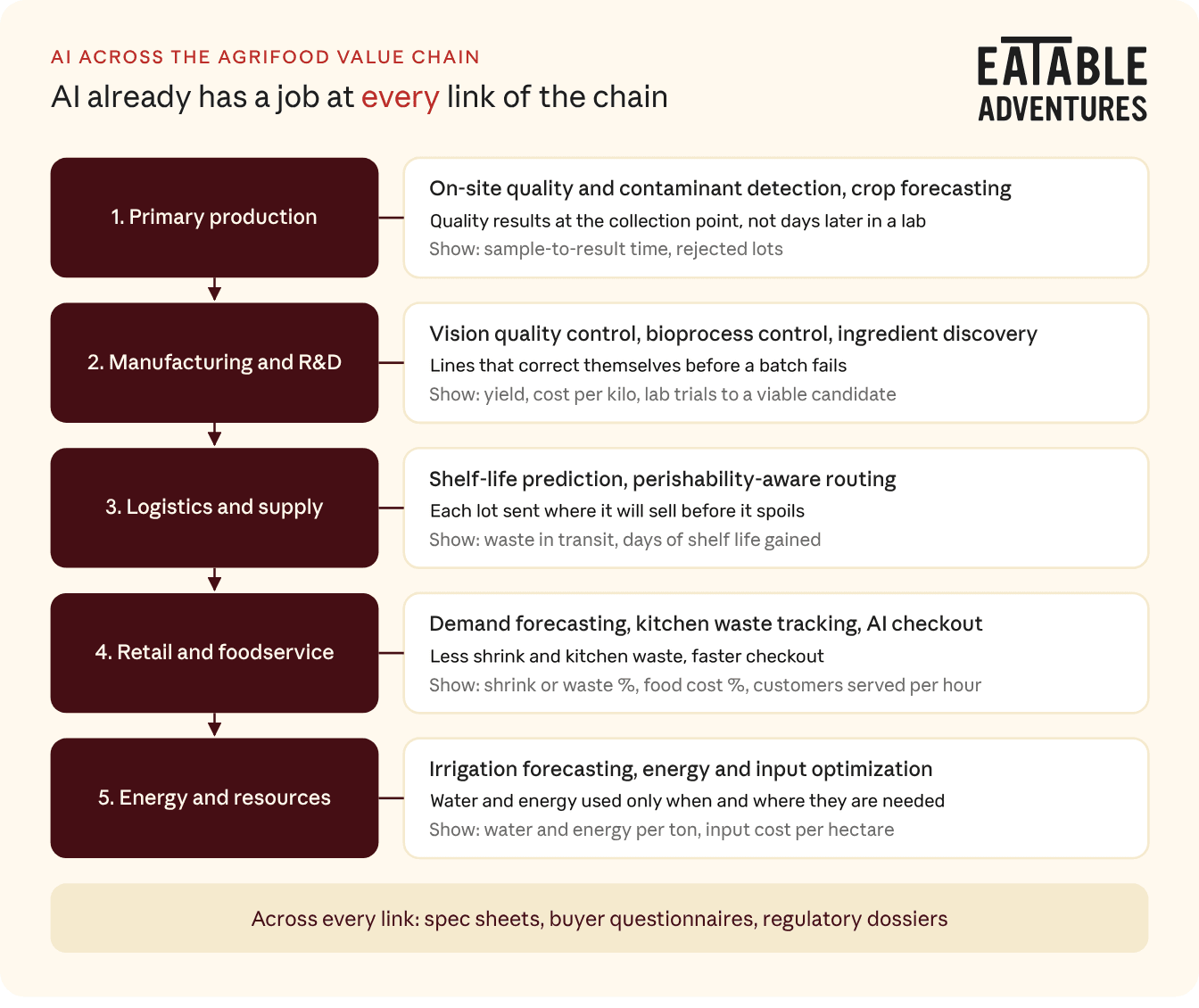
1. Primary production: AI at the farm and the collection point
In primary production, AI moves quality and safety testing from distant labs to the place where crops are collected, and turns field data into yield forecasts.
The problem. Quality and safety are decided at source, but measured far from it. Samples travel to distant labs, results arrive days later, and by then the crop has been sold, mixed or rejected.
Where AI fits:
- On-site quality and contaminant detection with imaging and computer vision
- Crop health and yield forecasting from field, drone and satellite data
- Grading and sorting at harvest
Startups doing it. Aflabox, from Italy, tests crops for mycotoxins with a portable imaging device and AI, with results in under 90 seconds at the collection point. It raised a €1.35M seed in August 2026 to scale in Kenya and Nigeria.⁶
The number to show: time from sample to result, share of rejected lots, and price premium for verified quality.
2. Food manufacturing and R&D: AI on the line and in the lab
In food manufacturing, AI keeps batches within spec by adjusting the line in real time. In R&D, it narrows the search for new ingredients before the first lab trial.
The problem. Small variations in raw material, temperature or timing decide whether a batch passes. And for ingredient companies, the most expensive step comes before production: finding a candidate worth producing.
Where AI fits:
- Vision-based quality control that adjusts the line, not just flags defects
- Process models that guide fermentation and other bioprocesses
- Screening and discovery of ingredients and compounds before the lab
Startups doing it. Polysense, in Ghent, sells vision systems that adjust process settings automatically, already running in factories such as Agristo and Poppies Bakeries.⁷ In Colombia, Sporalys uses AI to guide koji fermentation that turns by-products into a higher-value ingredient.⁸ In the US, Brightseed has mapped more than 2 million plant compounds to find new ingredients.⁹
The number to show: yield, rejected batches and cost per kilo in production; months and lab trials to a viable candidate in R&D.
3. Logistics and supply: AI that routes food by its real condition
In logistics, AI predicts how much shelf life each lot has left, so fresh food goes where it will sell in time instead of where the calendar says.
The problem. Fresh food is routed by date and distance, not by its real condition. A pallet that will spoil in three days travels as far as one that will last ten.
Where AI fits:
- Shelf-life prediction from sensors and scanners, so each lot goes where it will sell in time
- Route and inventory planning that accounts for perishability
- Supplier quality and traceability checks at reception
Startups doing it. OneThird, from the Netherlands, scans produce with near-infrared and AI to estimate its remaining shelf life, so shorter-lived lots go to nearer markets. The company says it can cut produce waste by up to 25%.¹⁰
The number to show: waste in transit, days of shelf life gained, and claims or rejections from buyers.
4. Retail and foodservice: AI against shrink and waste
In retail and foodservice, AI protects thin margins by forecasting fresh demand, tracking what gets thrown away and speeding up checkout.
The problem. Margins in fresh food and hospitality are thin, and they leak in two places: what spoils or gets thrown away, and the labor spent on ordering, serving and checkout.
Where AI fits:
- Demand forecasting and automated ordering for fresh categories
- Waste tracking in kitchens with cameras and scales
- Computer-vision checkout and self-service
Startups doing it. Afresh’s ordering system cut produce shrink by 18% at the US chain Cub in 2022.¹¹ Winnow’s bin cameras report 40–70% less kitchen waste.¹² In Spain, Proppos’s AI checkout identifies every item on a tray in under 1.5 seconds.¹³
The number to show: shrink or waste %, food cost %, and customers served per hour.
5. Energy and resources: AI for water, energy and inputs
In energy and resources, AI replaces calendar-based decisions with forecasts, so water, energy and inputs are used only when and where they are needed.
The problem. Water, energy and inputs are among the largest and most volatile costs in food, and they are still managed by habit and calendar more than by data.
Where AI fits:
- Irrigation and water forecasting from sensor, drone and satellite data
- Energy optimization in processing plants and cold storage
- Input planning for fertilizers and treatments
Startups doing it. Gyre Energy, from Oxford, combines AI with thermal energy storage so cold stores build up cooling when power is cheap and run less at peak hours. In its first commercial deployment, at a UK frozen-food distributor, it cut electricity costs by 38% and daily energy use by 35%, with payback in under 18 months.¹⁴
The number to show: water or energy per ton produced, input cost per hectare, and yield per unit of water.
Wherever you sit on the map, the method is the same: pick one problem in your link, measure it before you touch it, and show the number after. That is what turns “we use AI” into a reason to buy, or to invest.