
Since August 12, 2026, packaging that does not comply with Regulation (EU) 2025/40 on packaging and packaging waste (PPWR) can no longer be placed on the EU market. There is no general transition period and no extension: the European Commission ruled out a delay in writing, despite pressure from several industry associations.
For the food industry, the real shift is not the date. Packaging is no longer just a matter of design, cost and marketing; it now follows a regulatory timeline that runs through 2040. Some obligations can be met with paperwork. Others require materials, processes or logistics models that are not yet available at scale.
This article covers what the regulation already requires, what comes next, and where the answer lies in innovation, not just compliance.
What is the PPWR, the EU packaging regulation?
The PPWR (Packaging and Packaging Waste Regulation) is Regulation (EU) 2025/40 on packaging and packaging waste. It has applied since August 12, 2026, replaces Directive 94/62/EC, and sets requirements on composition, recyclability, recycled content, labeling and reuse for all packaging placed on the EU market, regardless of material or origin.
The key difference is legal. A directive is transposed into national law and leaves each country room to maneuver; a regulation applies directly and uniformly in all 27 Member States. That reduces fragmentation, but it also removes national room for interpretation on the essentials.
In Spain, the PPWR coexists with Law 7/2022 on waste and Royal Decree 1055/2022 on packaging, which remains in force where compatible. The government is drafting a new Royal Decree on packaging to align national rules; its prior public consultation closed on June 5, 2026. In the meantime, operational questions such as the governance of the deposit return system remain open.
In 2026 the Commission published implementation guidance and a set of frequently asked questions. Member States have until February 12, 2027, to set their penalty regimes.
What does the PPWR require since August 12, 2026?
Since August 12, 2026, the PPWR has required food companies to do four things: issue a declaration of conformity for each packaging type, meet the PFAS limits for food-contact packaging, comply with the heavy metals limit, and take on extended producer responsibility. These are mostly documentation and composition obligations:
- EU declaration of conformity and technical documentation. Each packaging type needs a declaration showing that it meets the regulation’s sustainability requirements (Articles 5 to 12), backed by information on materials, design, applicable standards and testing.
- PFAS limits for food-contact packaging. PFAS are compounds that repel grease and water and barely break down, so they accumulate in the environment. Food-contact packaging cannot be placed on the market if it reaches 25 ppb for any individual PFAS, 250 ppb for the sum of measured PFAS, or 50 ppm for total PFAS, including polymeric PFAS. There is no sell-through period: packaging made before August but placed on the market afterward must also comply.
- Heavy metals. The limit of 100 mg/kg for the combined concentration of lead, cadmium, mercury and hexavalent chromium remains in place for all packaging, not just food packaging.
- Extended producer responsibility. Joining the producer responsibility scheme in each country where products are sold, and registering as a producer as Member States set up their national registers (Articles 44 and 45).
One important caveat: the Commission itself acknowledges that there is still no harmonized EU method for measuring PFAS in food packaging. It recommends a step-by-step approach, starting with total fluorine.
In practice, companies’ questions focus on how to apply the regulation in day-to-day operations: who takes on each responsibility, what documentation must exist, and how to manage the declaration of conformity. “The first months are showing that compliance is also a data management challenge,” says Àlex Brossa Enrique, Cluster Manager at Packaging Cluster. Brands need traceability for every product reference, with technical information that is reliable, up to date and well structured.
One of the first questions is who counts as the producer. According to AECOC, the Spanish association of manufacturers and retailers, the general rule is to identify who owns the brand or who sets the specifications for the packaging or packaged product. This has direct consequences for private labels: “For private-label products, retail groups usually take on extended producer responsibility obligations, since they own the brand. This makes it necessary to strengthen coordination between retailers and suppliers, especially to have detailed and reliable information on packaging, its materials and its characteristics,” says Cinta Bosch, Sustainability Manager at AECOC.
What is the PPWR timeline through 2040?
The PPWR has applied since August 12, 2026, but the big technical leap comes on January 1, 2030, when mandatory recyclability, minimum recycled content, the empty space limit and the ban on several single-use plastic formats take effect.
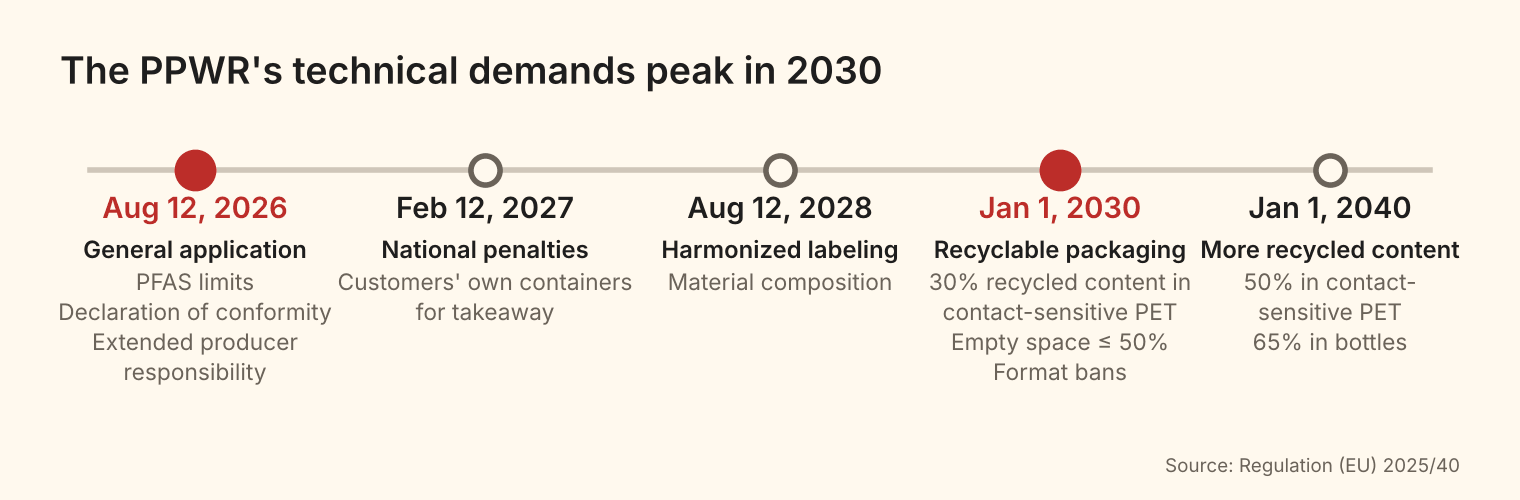
The milestones are not to scale. Several 2030 obligations are automatically postponed if the Commission is late in adopting the acts that implement them. Between 2030 and 2040 there are intermediate recyclability and reuse milestones worth tracking in the Commission’s delegated acts.
| Date | What takes effect | Articles |
|---|---|---|
| August 12, 2026 | General application; PFAS limits for food-contact packaging; EU declaration of conformity | 5, 38, 71 |
| February 12, 2027 | National penalty regimes; accepting customers’ own containers for takeaway food and drinks | 32, 68 |
| August 12, 2028 | Harmonized material composition label | 12 |
| January 1, 2030 | Recyclable packaging (grade A, B or C); minimum recycled content: 30% in contact-sensitive PET and 10% in other contact-sensitive plastics; maximum empty space ratio of 50%; ban on the formats listed in Annex V | 6, 7, 24, 25 |
| January 1, 2038 | Minimum recyclability grade B | 6 |
| January 1, 2040 | Minimum recycled content: 50% in contact-sensitive PET, 25% in other contact-sensitive plastics and 65% in single-use bottles | 7 |
What innovation challenges does the PPWR create for the food industry?
The PPWR creates five innovation challenges for the food industry: replacing PFAS as a grease barrier, securing recycled plastic approved for food contact, making multilayer packaging recyclable, removing plastic from fruit and vegetable packaging, and reducing empty space and single-use packaging. Meeting the documentation requirements is a matter of method. The 2030 and 2040 requirements, by contrast, raise technical problems that few companies can solve with their usual suppliers alone. These are the five with the greatest impact on the food industry.
1. Grease barriers without PFAS
PFAS were used in paper and board to repel grease and moisture: fast food packaging, baked goods, snacks and pet food. Replacing them requires alternative coatings that keep the barrier, do not compromise paper recyclability and pass food-contact testing.
2. Recycled plastic approved for food contact
By 2030, contact-sensitive PET packaging must contain 30% post-consumer recycled plastic, and other contact-sensitive plastics 10%. In 2040, those figures rise to 50% and 25%. The bottleneck is not willingness but supply: most recycled plastic available today is not approved for food contact. The regulation itself provides for a review of the role of bio-based feedstock if there are not enough suitable recycling technologies.
3. Recyclability without losing shelf life
From 2030, all packaging must reach at least grade C on an A, B, C recyclability scale; from 2038, at least grade B. Many food packages use multilayer structures precisely because they protect the product better. Moving to mono-material without shortening shelf life is one of the clearest R&D problems the regulation leaves behind.
Technology centers are already working on this, and it ties back to the PFAS challenge. “We work with coatings that provide a barrier to oxygen, water and grease and replace PFAS in food-contact packaging. Their thickness, a few nanometers or microns, is negligible compared with the total weight of the packaging, so it can be considered mono-material. We are also working to make some of these coatings easy to remove,” says Ruth Díez Ahedo, Agrifood Coordinator at Tekniker.
Tekniker applies these coatings in liquid phase using sol-gel technology, and also works with nanometer-thin vapor-phase metallization (CVD and ALD), although ALD is still far from being a low-cost industrial option for packaging. Which coatings allow packaging to count as mono-material will be set by the design-for-recycling criteria the Commission must adopt by 2028.
4. Fruit and vegetables without single-use plastic
From January 1, 2030, the PPWR bans single-use plastic packaging for pre-packed fresh fruit and vegetables under 1.5 kg. Each Member State may set exemptions where packaging is needed to prevent water loss, physical damage, oxidation or microbial hazards. Here the challenge links to another one: reducing packaging without increasing food waste. Edible coatings, freshness sensors and new preservation formats become part of the answer.
The regulation prioritizes material recycling, but it leaves a role for compostable packaging: Member States may require it for certain formats if they already did so before the regulation applied and have suitable bio-waste collection and treatment (Article 9). According to PeelPack, Italy has already legislated along these lines for fruit and vegetable packs under 1.5 kg.
Getting from a promising material to packaging on the shelf takes more than compliance. “Our pilots showed that customers need a credible path from a promising material to reliable production. Growers and packers need product protection; converters need consistent processing; retailers need dependable supply, clear disposal instructions and workable economics,” says Massimo Bagnani, Co-founder & CTO of PeelPack. The startup has already processed several tonnes of its material, Materra®, on conventional industrial lines.
5. Less empty space and more reuse
From 2030, grouped, transport and e-commerce packaging may not exceed 50% empty space, and single-use plastic shrink wrap used at the point of sale to bundle cans or bottles and encourage multi-unit purchases is banned. The regulation also sets reuse targets for transport packaging. This affects logistics, relationships with retailers, and the data needed to manage fleets of returnable packaging.
Startups already working on these challenges
For Cinta Bosch of AECOC, collaboration with startups and technology centers “makes it possible to explore new materials, develop packaging solutions and speed up the adoption of technological advances.” Several startups in the Eatable Adventures portfolio are already developing solutions to these challenges. Performance data comes from the companies themselves.
| Startup | What it does | Challenge |
|---|---|---|
| PeelPack | Compostable trays for fruit and vegetables made from potato peels and potato industry side streams, using a patented thermoforming process. | Fruit and vegetables without single-use plastic |
| Alkelux | An antimicrobial additive made from licorice root waste. Manufacturers blend it at 0.1% into plastic or cellulose without changing their lines. In its tests, strawberry shelf life goes from 3 to 8 or 9 days. | Shelf life with simpler packaging |
| Mama Science | Biomact, a plant-based, biodegradable biomaterial used as a board coating, as an edible coating on the food itself, or as a film to replace plastic. According to its internal tests, it extends shelf life by 30% to 70% depending on the product. | Plastic alternatives and shelf life |
| Agreenet | PìFresc®, a label placed inside the package that releases natural ingredients to slow mold growth on fruit and vegetables. | Less packaging without more waste |
How do you move from a requirement to an innovation pilot?
Redesigning packaging takes time: validating a new material means barrier, shelf-life, food-contact and recyclability testing, plus adapting packing lines. With 2030 on the horizon, there is less room to test and discard than it seems.
That is why each requirement is best treated as a specific challenge rather than a generic sustainability project:
- Define the problem. Which package, which product, which requirement, and what technical, cost or line constraints apply.
- Map the solutions. Materials and coatings startups, packaging technology centers, suppliers and research projects. Distinguish what is already commercial from what is still at pilot stage.
- Test against agreed metrics. Barrier, shelf life, unit cost, line compatibility and recyclability grade, before committing to a format change.
“Recyclability will be one of the major challenges. Meeting it will require working as an ecosystem, because replacing a material is not enough: you will have to show with data that the solution meets environmental and regulatory requirements and, at the same time, check that it works in real industrial conditions, maintaining performance, food safety, line efficiency, convenience and cost.”
Àlex Brossa Enrique, Cluster Manager at Packaging Cluster
PPWR checklist: five questions to review your packaging portfolio
- Do we have an inventory of all our food-contact packaging and its PFAS evidence?
- Does every packaging type have a declaration of conformity and technical documentation?
- Which of our packaging would not be recyclable under the 2030 criteria?
- What share of food-contact recycled plastic can we secure from our suppliers today?
- Which formats affected by the 2030 bans are we still using?
How can Eatable Adventures help with PPWR challenges?
The 2030 requirements can rarely be met from a usual supplier’s catalog. More often, the answer lies outside: a startup with a new material, a technology center to validate it, or a pilot that proves it works on the line.
At Eatable Adventures, we support food companies through that process, following the three steps described in this article:
- Define the challenge. We pin down which package, which requirement, and which line, cost or shelf-life constraints need to be solved.
- Find solutions. We look for candidates in a database of more than 10,000 startups and solvers, and in our portfolio of more than 40 startups.
- Test before deciding. We design and support the pilot with agreed metrics. In 2025 alone, 65 pilots were launched with agrifood corporations.
Which PPWR requirement poses the biggest challenge for your organization? Tell us which package or requirement concerns you, and someone from our team will get in touch to discuss how to approach it.
PPWR frequently asked questions
When did the PPWR become mandatory?
Regulation (EU) 2025/40 has applied since August 12, 2026, in all 27 Member States, with no need for transposition (Article 71). The European Commission ruled out postponing that date. Other obligations, such as recyclability and minimum recycled content, are phased in between 2027 and 2040.
Which companies does the PPWR affect?
All operators that place packaging or packaged products on the EU market: manufacturers, producers, importers and distributors, regardless of packaging material or origin. In the food sector, it affects brands, packaging manufacturers and retailers.
What PFAS limits does the PPWR set?
Since August 12, 2026, food-contact packaging may not contain PFAS at or above 25 ppb for any individual PFAS, 250 ppb for the sum of measured PFAS, or 50 ppm for total PFAS, including polymeric PFAS (Article 5(5)).
Can packaging made before August 12, 2026, still be sold?
It depends on when it was placed on the market. Packaging that was already on the EU market before that date, for example in a distributor’s stock, does not have to meet the new requirements. Packaging made earlier but placed on the market for the first time afterward must comply.
How does the PPWR apply in Spain?
It applies directly, alongside Law 7/2022 on waste and Royal Decree 1055/2022 on packaging, which remains in force where compatible. The government is drafting a new Royal Decree on packaging to align the national framework and settle details such as the deposit return system.
What penalties does the PPWR provide for?
The regulation does not set EU-wide fines. Each Member State must set its own penalty regime by February 12, 2027, and penalties must be effective, proportionate and dissuasive. For Articles 24 to 29, they must include administrative fines (Article 68).
Sources
- Official text: Regulation (EU) 2025/40 on EUR-Lex
- Cooley: an introduction to the PPWR
- Lynx Legal: obligations since August 12, 2026
- Faegre Drinker: obligations for manufacturers and national penalties
- Food Packaging Forum: PFAS limits and Commission guidance
- Socotec: PFAS and heavy metals
- Keller and Heckman: recycled content and 2030 bans
- Ecomundo: recycled content targets for 2030 and 2040
- EUWID: the Commission rules out postponing the PPWR
- Interempresas: the PPWR and Spain’s new Royal Decree on packaging (in Spanish)